
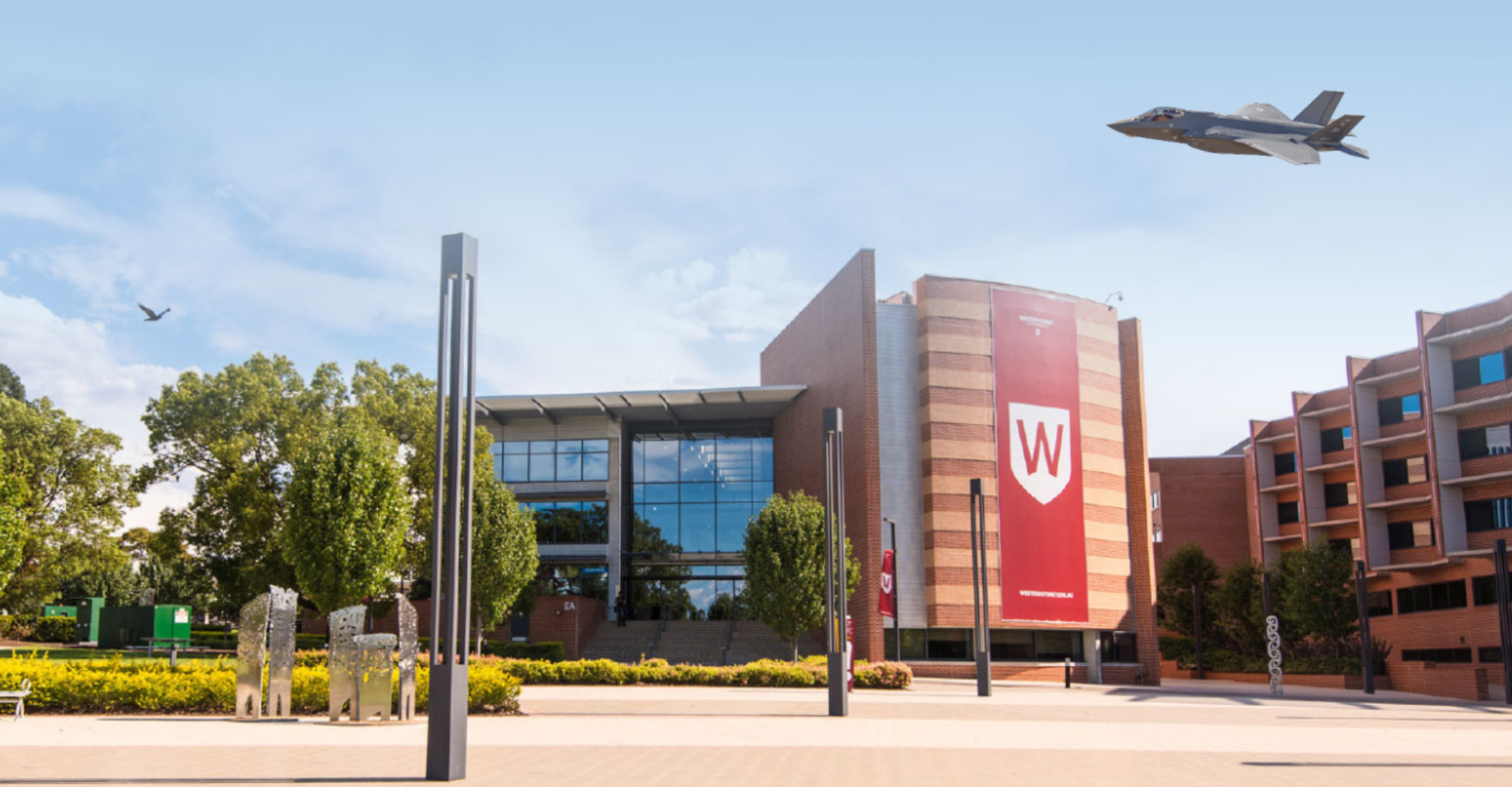
For years, Western Sydney University (WSU) students have criticised the university’s research partnerships with military and defence companies.
Earlier in 2026 This year, WSU’s SRC released an open letter to Vice Chancellor George Williams to condemn the University’s “close partnerships… with industries of war” and the renewal of a three-yearMemorandum of Understanding with Lockheed Martin to develop the C-130J Super Hercules, an aircraft which is regularly used by the Israeli Air Force (IAF).
Activist group Students for Palestine launched their WSU Weapons Off Campus campaign in April and have been protesting Israel’s attacks on Gaza and the West Bank since October 2023.
WSU’s research partnerships with weapons companies and defence forces
WSU’s International Centre for Neuromorphic Systems (ICNS) develops artificial intelligence which mimics brain neurons to engineer “more efficient, reliable, and versatile computing systems”, and is part of WSU’s MARCS Institute for Brain, Behaviour and Development (MARCS).
WSU’s website states that their work with neuromorphic systems is improving autonomous systems and the research is focused “squarely on our partner’s challenges”. Meanwhile, ICNS is partnered with many defence organisations.
ICNS’ partners include the Australian government’s department of defence (ADF), Raytheon, the Australian Royal Air Force (ARAF), U.S Air Force Academy (USAFA), Defence Innovation Network (DIN), Royal Australian Navy (RAN) and other defence organisations.
Neuromorphic systems mimic the structure of human’s brains using artificial neurons. The technology aims to react to situations in ways that any human would. They also aim to minimise the amount of data required to make decisions. MARCS has conducted research into projects that utilise neuromorphic technology to benefit Indigenous people, people with dementia, people with mental health conditions and so on.
Despite these positive uses of neuromorphic technology, ICNS’s partnerships with USAFA, the ADF and other defence organisations raises concerns regarding how this technology will be applied in future.
MARCS’ projects have also been funded by Department of Defence, Thales, USAFA, Office of Naval Research, DIN and Silentium. All these organisations conduct research into defence technology.
In the 2025-2026 NSW Budget Estimates, it was revealed that WSU has received funding in the amount of $778,125 from BAE Systems, and $74,451 from Raytheon.
How these companies use neuromorphic technology
BAE Systems (BAE), an Australian defence company which “ICNS collaborates closely with” describes themselves as providing “air, maritime, land, strategic surveillance, guided weapons and autonomy” to the ADF. BAE also works with Saudi Arabia‘s government to improve their defence and security.
In 2021, ICNS was part of a project led by BAE which explored long-range drone detection. BAE has multiple long-range drone systems which may be used in warfare.
Raytheon states that “a neuromorphic approach… could revolutionize how intelligent sensors are deployed on the battlefield”. In 2023, ICNS collaborated with Raytheon to investigate drone detection in the maritime environment.
The joint U.S Air Force-Navy’s AGM-158B-2 is one example of an autonomous weapon which in 2025 was projected for production in 2026.
Staff and student comments
WSU Vice Chancellor George Williams says individual academics manage their partnerships with companies according to ethical frameworks, but ultimately that decision is with the academic.
When questioned about these partnerships, a WSU spokesperson told W’SUP that:
“All research partnerships are assessed against Western Sydney University’s ethical framework, which requires evaluation of partner affiliations, dual-use considerations, public good impact and compliance with Australian law
An additional WSU spokesperson told W’SUP that university research funded by defence companies and the department of defence is “important because many the world’s smartest people are academics”. The spokesperson also referenced dual use technologies, job creation and economic growth to justify ADF funded University research as important.