
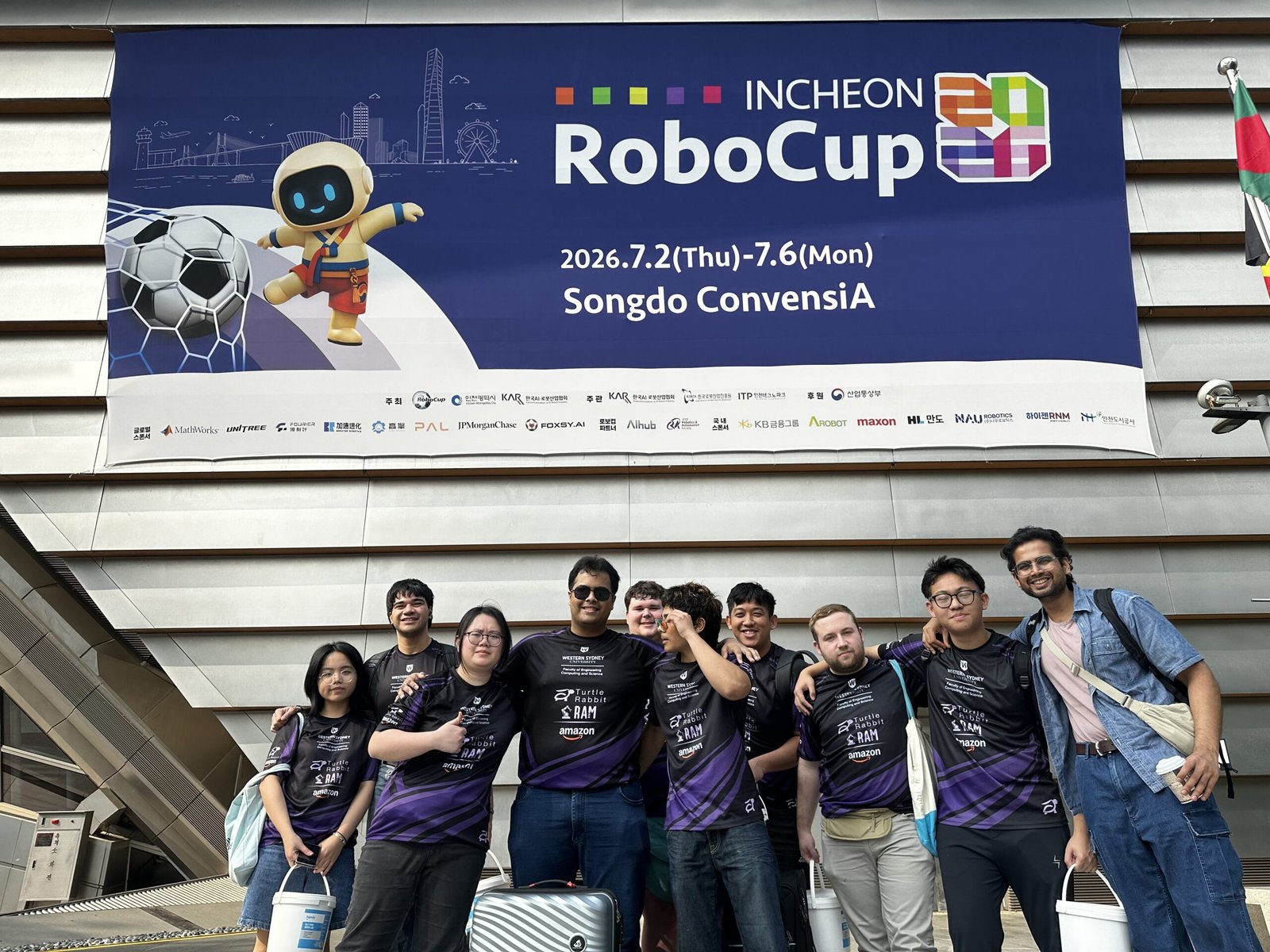
Bedridden with food poisoning in Incheon, South Korea, Tharunimm “TJ” Jamal watched a live stream as robots his team had built from scratch won their first-ever match at RoboCup 2026. Just a day earlier, the Western Sydney University students had wondered whether they would win at all.
Jamal is president of WSU’s Robotics, Automation and Manufacturing (RAM) Club, which runs the TurtleRabbit team. In July, the club sent 10 students and one academic to the international robot soccer competition. Up against 14 other teams in Division B of the Small-Size League, they finished second in their group.
Robots in the carry-on
The adventure began before they even left Sydney. The team packed their robots in their hand luggage, raising eyebrows at airport security.
“They’re like, ‘What is this? What are you carrying?’” Jamal said.
The answer: soccer players. Picture a match where every player is a small wheeled robot and nobody holds a controller. A camera above the field tracks the ball, while code decides every pass, block and shot.
“It’s a bunch of small robots playing soccer individually, autonomously, against another team,” said Jamal, who is studying a Bachelor of Engineering (Honours) in Robotics and Mechatronics.
For Liam Vercueil, the club’s sponsorships and outreach lead and a Bachelor of Computer Science student, the magic is that nothing comes out of a box.
“In our league, teams literally build their robots from scratch, which I think is a really good learning opportunity, especially for people that are new to robots.”
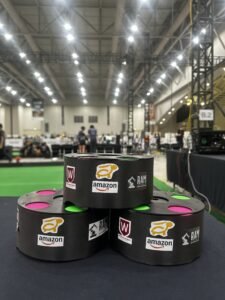
TurtleRabbit’s home-built robots at the competition venue. Title: TurtleRabbit’s robots. Photo: Destinee Diwakar.
The longest night
Then came the first match, and the robots stopped working.
“It was more of a moment of, oh, what do we do?” Jamal said. “And immediately the software team went to work.”
They booked a practice field and coded until 2am or 3am. By 6am or 7am, they were back at the venue on about three hours’ sleep.
Their next match brought TurtleRabbit’s first-ever win.
“I remember jumping in my room,” Jamal said.
On the field, one of the team’s younger members marked every goal with a Cristiano Ronaldo-style celebration.
“In the middle of all these serious teams, there’s just this one random kid from Australia … screaming at the top of his lungs.”
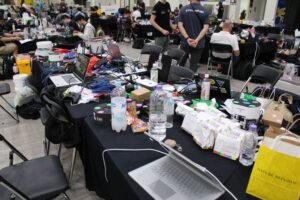
The TurtleRabbit team’s workstation at the competition. Title: The team’s workstation. Photo: Tristian Trieu.
Turtles, rabbits and a big ask
The team’s name goes back to the club’s early days, when beginners learned slowly in “Team Turtle” and experienced seniors raced ahead in “Team Rabbit.” The split didn’t work, so the two merged.
Getting to Korea was a race of its own. With unfinished robots and very little money, Jamal took the team’s case to university leaders.
“Whatever happens today either makes or breaks the team for the next few years to come,” he remembers thinking.
It made the team. The university covered a large part of the costs, and two weeks later, Amazon signed on as a partner.
More than code
For club secretary Naomi Luyen, a Bachelor of Data Science student, the pressure in Incheon was real. So was the care.
“We always make sure everyone is mentally and physically okay,” she said.
When the decision-making system Vercueil had worked on failed at the competition, a teammate’s new system took over. It stung, but the wins helped him see the bigger picture.
“It doesn’t matter whose code we’re using,” he said.
Jamal agrees. “There is no such thing as a perfect team. But we were there for each other when we needed it, and I think that’s what matters the most.”
Rivals, then friends
At first, the competition was daunting. One team from Japan even brought its own server rack. But rivals soon became friends.
“Yes, it’s a competition, but at the end of the day, RoboCup is also one of the world’s largest robotic symposiums,” Jamal said. “Everyone there is there to support each other.”
The team grew close to reigning champions TIGERs Mannheim from Germany and French team NAMeC, even after beating them.
“It felt really bad when we defeated them,” Jamal admitted.
For Vercueil, an international student, it all still feels unreal.
“I’m not even from Australia,” he said. “And then all of a sudden … I’m now in South Korea competing in an international competition.”
What’s next
Next year, the club plans to step into RoboCup’s Humanoid League with six new humanoid robots, and it’s looking for new members from every kind of degree.
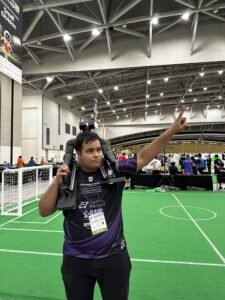
Club president Tharunimm “TJ” Jamal with a humanoid robot at RoboCup 2026. Title: TJ with a humanoid robot. Photo: Destinee Diwakar.
Asked to sum up the experience in one word, Luyen chose “opportunities” and Vercueil chose “surreal,” while Jamal went with “humbling”.
“We’ve learned our place in the universe because of it,” he said. “And we’ve also learned what we want to do in the future because of it.”
Written by: Reihaneh Rahmati